
Military History Across a Connected Mediterranean World
A campaign in North Africa could change the choices available in southern Europe, while a decision made in a European capital could mobilize soldiers and workers thousands of miles away. European and African military histories are connected through empire, trade, migration, coalition warfare, resistance, and the movement of people and resources. Studying them together reveals relationships that disappear when campaigns are presented as isolated lists of battles. It also requires care: Africa is not a single battlefield, European forces were never the only participants, and a military victory did not necessarily produce the political outcome its leaders intended. This introduction follows the connections between the two continents from imperial campaigns through the world wars and the development of international peacekeeping. Its aim is to establish a historical framework while keeping the societies affected by campaigns as visible as the commanders who directed them.
What Makes a Campaign Different From a Battle
A battle is an episode of fighting, while a campaign connects a series of military activities toward an objective across time and space. A campaign history must explain why forces were there, how they were supported, what political purpose they served, and how separate actions related to one another. Official campaign credits, geographical theaters, and a historian’s analytical categories can organize the same events differently. The U.S. Army’s World War II campaign summaries illustrate one institutional approach. Readers should understand what a label includes before comparing it with another account, especially when several operations took place at the same time.
The Zulu War Shows Why a Battle Is Not the Whole Campaign
In January 1879, British forces invaded the Zulu kingdom in southern Africa. The campaign arose from imperial efforts to extend control, rather than an encounter between armies with no political context. King Cetshwayo’s kingdom had its own government and military organization. A history beginning only when British troops reached a battlefield would leave out the authority being challenged.
At Isandlwana on January 22, Zulu forces defeated a British force. On July 4, the British defeated the Zulu army at Ulundi. These two results belong to the same war. The sequence is an immediate warning against assuming that a celebrated tactical victory determines the entire campaign. Reinforcement, further operations, resources, and political objectives continued after the first encounter.
The National Army Museum’s collection preserves material from the conflict, including a shield taken at Ulundi. Such an object can establish a concrete connection with the campaign while also raising a question about how it entered a European collection. The war altered political power and produced a legacy of objects, records, and remembrance. Studying both the campaign and its surviving material keeps conquest’s consequences visible beyond the battlefield.
The Mendi Connects African Labor With the Western Front
On February 21, 1917, the troopship Mendi sank after a collision in the English Channel while carrying members of the South African Native Labour Corps toward France. More than 600 Black South Africans died. These men were traveling to support the Western Front as noncombatant laborers. Their work included the transport and construction tasks sustaining an immense military organization. The ship’s loss connects an African recruitment system, a sea journey, and a European campaign in one event. It also makes the limitations of a combat-only history obvious: men could die in military service without reaching a trench or carrying out an infantry assault. Historic England’s research and South Africa’s heritage record preserve the wreck and the voyage as parts of that connected history.
North Africa Opened a Sequence Toward Sicily and Italy
Operation Torch brought Allied landings to French North Africa on November 8, 1942, including Casablanca, Oran, and Algiers. The campaign subsequently connected with fighting in Tunisia, where Axis resistance ended in May 1943. These were linked stages, not one continuous battle. Ports, sea movement, air activity, and armies advancing overland all contributed to the result.
The Allies then invaded Sicily in July 1943 before continuing operations in mainland Italy. The sequence shows how one campaign’s outcome can create options for another. It does not mean that success in Tunisia supplied an automatic solution in Sicily. An amphibious landing, a mountainous advance, and an army’s supply across the Mediterranean presented different problems. The connection lay in strategic choices and the forces available to carry them out.
Coalition Warfare Required Continuing Negotiation
Allied cooperation combined military organizations with different resources, priorities, traditions, and political responsibilities. Sharing an adversary did not eliminate disagreement about where to concentrate effort or how to distribute burdens. Command arrangements and planning processes were therefore part of the campaign’s substance. They helped turn separate national contributions into activity directed toward a common objective.
The same principle applies to the historical interpretation of a coalition’s success. A single national account can accurately describe one contribution while leaving out the wider setting that made it possible. Campaign histories become more complete when they connect combat formations with shipping, production, intelligence, labor, and the decisions of partner governments. These relationships explain capability more effectively than a list of the most celebrated units.
Participation also did not guarantee equal treatment or recognition. Imperial hierarchies and discrimination shaped military service and postwar remembrance. Readers should therefore ask whose accounts survived, whose service was formally recorded, and whose contribution received public acknowledgment. Those are historical questions about evidence and institutions, not distractions from the military story. They help explain why the public memory of a campaign can differ substantially from the range of people who sustained it.
Compare the Supply Journey, Not Just the Vehicle
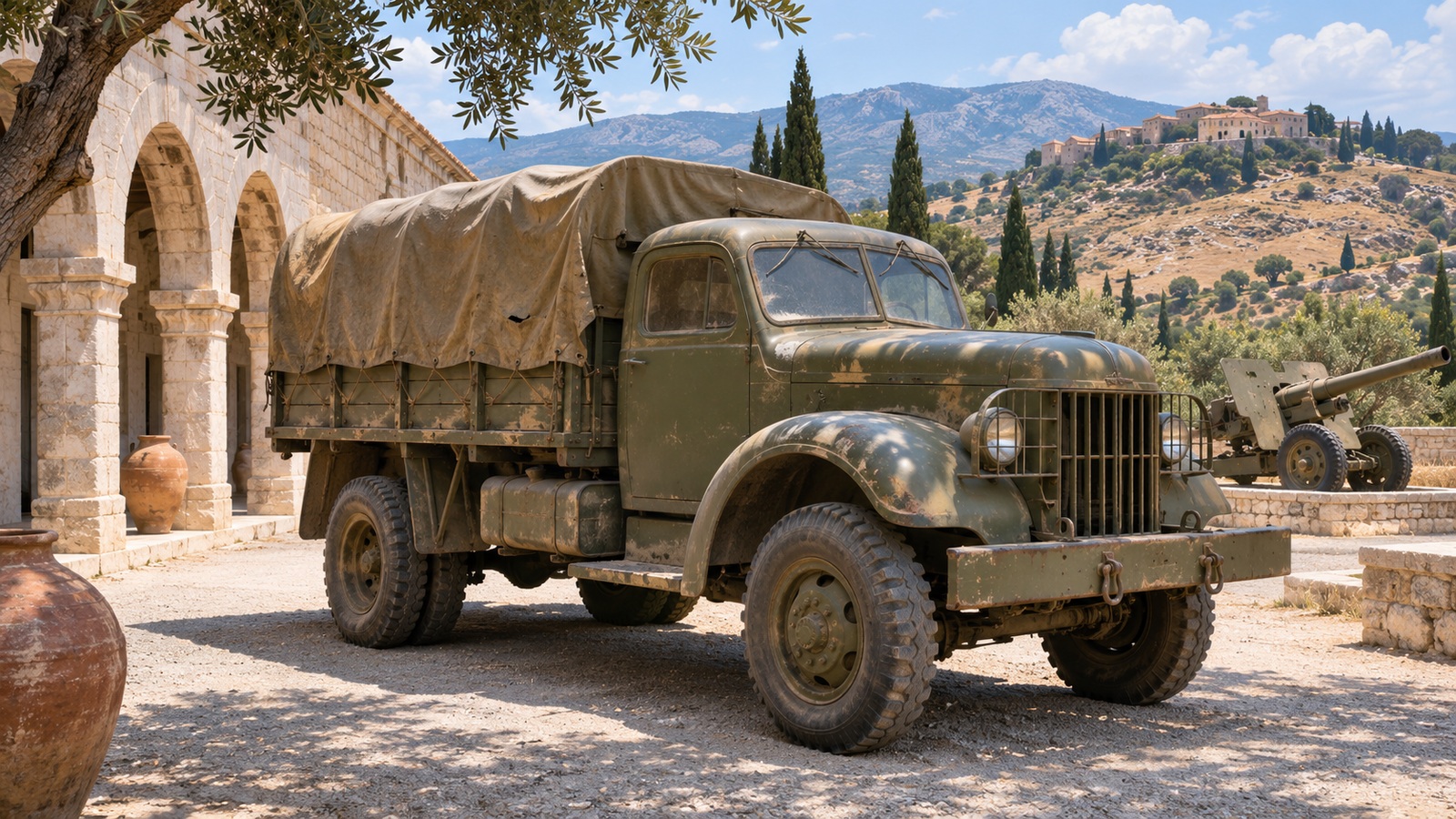
A truck displayed in a museum can introduce a campaign, but the useful question is the journey it served. In North Africa, supplies had to move from available ports across substantial distances to fighting formations. In an amphibious campaign, people and equipment also had to transfer from sea transport to a contested shore. The same vehicle type could occupy a different place in each system.
Follow a medical requirement as another comparison. Casualties need treatment and movement, while medical personnel need equipment, supplies, and facilities. The U.S. Army’s Mediterranean medical history follows those arrangements through North Africa and subsequent campaigns. This perspective connects military movement with consequences for people. Terrain matters because it changes how the support organization reaches them, rather than simply providing an evocative desert or mountain backdrop.
A Cape Town Memorial Shows Recognition Changing a Century Later
On January 22, 2025, the Commonwealth War Graves Commission inaugurated the Cape Town Labour Corps Memorial in the Company’s Garden, commemorating by name more than 1,700 South Africans previously left without individual commemoration. These men had served in labor units in Africa; their service differed from that of the Native Labour Corps traveling toward Europe aboard Mendi. Each named hardwood post represents a person, making the supporting workforce visible through individual identities rather than an anonymous total. The commission describes research identifying the casualties as a necessary stage before design and construction, so the monument records an institutional correction as well as an act of remembrance. Placed near the existing Delville Wood memorial, it connects different wartime experiences within one public space and gives the question of unequal recognition a concrete object, date, and documented response.
Suez Links Military Action With Diplomatic Reversal
Egypt nationalized the Suez Canal Company in July 1956. Military action involving Israel, France, and the United Kingdom followed later that year. The crisis cannot be explained solely by tracing the movement of attacking forces. The attempt to impose an outcome through force encountered international diplomatic pressure, while Egypt’s sovereignty and control of the canal remained central political issues.
The United Nations established the First UN Emergency Force, or UNEF I. Its background history records the departure of British and French forces by December 1956 and the subsequent Israeli withdrawal. The mission’s work changed as withdrawals proceeded. This was a new assignment for military personnel under an international arrangement, rather than another force seeking to conquer the territory.
UNEF also had a finite political basis. It withdrew in May 1967 at Egypt’s request. The contrast between deployment and withdrawal shows why peacekeeping cannot be treated as a permanent mechanical solution installed after a war. Its presence depended on an institutional and political arrangement. Suez therefore connects three different subjects: the use of force, the diplomatic result, and the attempt to manage the resulting ceasefire.
The Congo Mission Began With Independence and a Request
The Republic of the Congo became independent from Belgium on June 30, 1960. Disorder followed, and Belgium sent troops without the Congolese government’s agreement. That government requested UN assistance on July 12. Security Council Resolution 143, adopted two days later, authorized the steps that established the UN Operation in the Congo, or ONUC. The initial tasks included Belgian withdrawal, assistance with law and order, and technical support.
The mission continued until June 1964 and became a much larger and more demanding undertaking than earlier observer missions. It should be studied through its own changing mandate and events. The UN’s historical account provides the institutional perspective; that perspective does not exhaust the experiences or political disagreements of Congolese participants. The point of the comparison with empire is specific: independence and an international mandate changed the formal relationship, while outside military activity remained deeply consequential for local authority.
How to Build a More Complete Campaign History
Begin with a map and chronology, then identify the political objective, participating societies, and supporting organization. Use official records for the institutional perspective while also considering personal testimony, local histories, and material evidence, recognizing that a preserved vehicle or uniform cannot tell the whole story of who served. The strongest introductory account follows how European and African histories shaped one another through decisions, movement, resistance, and cooperation. It recognizes African agency and the multinational nature of many forces while examining the unequal conditions under which people participated. That approach gives familiar battles a larger meaning and makes less familiar campaigns visible as part of the same connected historical world.
Let a Specific Record Lead to the Next Question
The Mendi offers a practical research sequence. A shipwreck record establishes a location and physical remains. A passenger or service record connects a person with the voyage. A recruitment history explains the organization that placed him aboard. A memorial shows how the loss was later represented. Each source adds something different, and none alone supplies the whole experience.
The Ulundi shield raises another sequence. A collection entry can identify an object and its recorded acquisition. The campaign history explains the fighting associated with it. Accounts of the Zulu kingdom place the object within the society from which it came. A museum display becomes more informative when those connections remain visible instead of allowing the object to stand simply for a British victory.
These methods connect Europe and Africa without dissolving their distinct histories. The cases move from imperial war to world-war labor, Mediterranean campaigns, Suez, and the Congo. They involve different governments, purposes, and forms of military service. What joins them is the movement of people, resources, and power across a connected world. An introduction becomes useful when it gives those relationships names, dates, and consequences that a reader can investigate further.