A Timeline With Several Clocks Running
The Pacific War is often remembered as a sequence of famous battles, beginning at Pearl Harbor and ending aboard a battleship in Tokyo Bay. That sequence is useful, but it can also hide the size of the conflict. Operations in China continued while fleets fought near Midway; campaigns in New Guinea overlapped with the struggle for the Solomon Islands; and political decisions in several capitals followed different calendars from events at sea. A clear timeline therefore needs more than dates in a row. It needs to show which developments occurred together, what changed between them, and why later knowledge should never make an earlier outcome look inevitable.
Key Dates at a Glance
The entries distinguish the beginning of a campaign from an announcement or ceremony. Campaigns elsewhere continued between these milestones. The final August entries use Japanese dates unless another location is specified.
| Date | Event | Change to follow in the narrative |
|---|---|---|
| December 7–8, 1941 | Pearl Harbor and wider Japanese offensives | Different local dates across the date line |
| May–June 1942 | Coral Sea, then Midway | Checks on expansion and a changed carrier balance |
| August 1942–February 1943 | Guadalcanal campaign | Supply and endurance across several months |
| Summer–October 1944 | Marianas campaigns, then Leyte landings | New base geography and a return to the Philippines |
| February–April 1945 | Iwo Jima, then Okinawa begin | Major fighting before the final surrender decisions |
| August 6, 1945 | Hiroshima atomic bombing | One event in a converging sequence |
| August 8–9, 1945 | Soviet declaration, then invasion of Manchuria | New continental military pressure |
| August 9, 1945 | Nagasaki atomic bombing | Another shock during the leadership debate |
| August 15, 1945 | Emperor’s broadcast in Japan | Public acceptance announcement |
| September 2, 1945 | Formal signing aboard USS Missouri | Military surrender ceremony, with implementation continuing |
Before December 1941: A Wider Asian War
Pearl Harbor marks the American entry into the war against Japan, rather than the beginning of warfare in Asia. Japan had occupied Manchuria in 1931, and full-scale war between China and Japan developed in 1937. Chinese military resistance, occupation, displacement, and civilian suffering were already central realities before American battleships were attacked in Hawaii. Starting the chronology earlier prevents an American turning point from replacing the experiences of the people already at war.
Japanese expansion also sharpened disputes over resources and the regional order. Economic restrictions and diplomatic negotiations formed part of the background to the decision for a wider war. These developments should be explained as choices made by governments under particular assumptions, rather than as a machine that automatically produced an attack. Leaders still decided what risks to accept and which alternatives to reject.
December 1941: Attacks Across an Ocean
Japanese aircraft attacked Pearl Harbor on December 7, 1941, Hawaiian time. Across the international date line, operations in parts of Asia began on December 8. The difference can make apparently conflicting dates correct when they refer to the same opening period in different locations. Attacks against American and British positions belonged to a wider offensive, so Pearl Harbor should be placed beside developments in Malaya, the Philippines, Hong Kong, and other threatened areas. The immediate result was an expanded war involving territories and populations far beyond Hawaii.
Early 1942: Expansion Outruns Allied Recovery
During the first months of 1942, Japanese forces achieved major advances across Southeast Asia and the western Pacific. Singapore fell in February, a profound defeat for Britain and its regional position. Fighting in the Philippines continued into the spring, with Bataan surrendering in April and Corregidor in May. These were separate campaigns with different commanders, local circumstances, and consequences for prisoners and civilians.
The speed of expansion created a dramatic change in the map, but territorial extent alone does not measure durable strength. Holding distant positions demanded shipping, aircraft, trained personnel, and reliable connections. Every new commitment added obligations to an already extensive war. The relationship between rapid conquest and the cost of maintaining it became increasingly important as Allied resistance strengthened.
For people living under occupation, the chronology followed another set of experiences. Changes in authority could bring violence, forced labor, shortages, and restrictions that continued long after an initial landing or surrender. A campaign date can mark the end of one military phase while beginning a much longer civilian ordeal. Both belong in the historical record.
May and June 1942: Two Naval Encounters
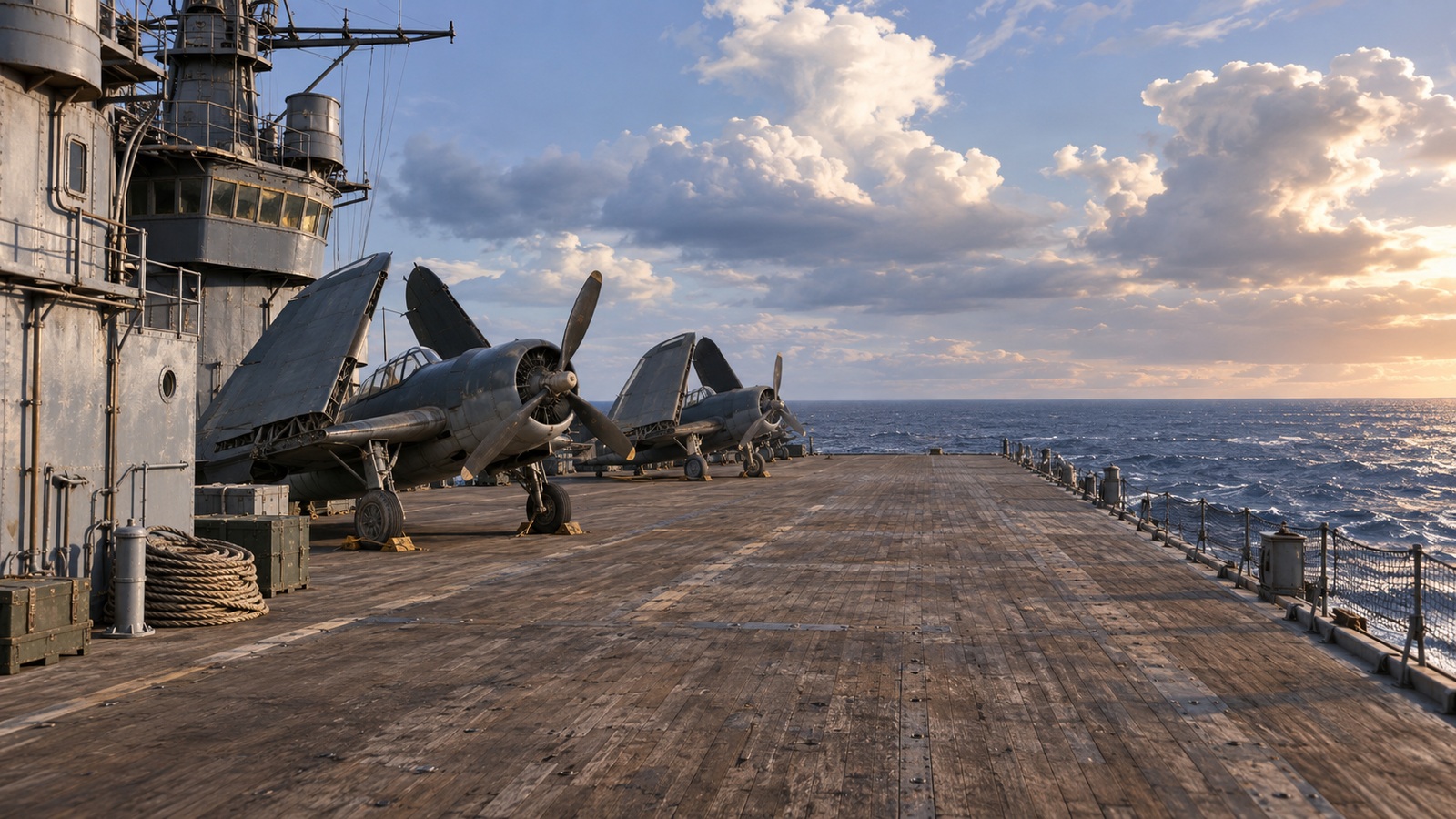
The Battle of the Coral Sea took place in May 1942. Its carrier fighting helped check the immediate Japanese seaborne move toward Port Moresby, although the broader New Guinea struggle continued. Calling it a check on one operation is more precise than suggesting that all threats to the region disappeared. The encounter also demonstrated how aviation could connect ships that did not fight through a traditional exchange of surface gunfire.
At Midway in June, Japan lost four aircraft carriers, materially changing the carrier balance. American victory mattered enormously, but it did not instantly reverse every Japanese position across the Pacific. Later operations still required planning, replacements, transport, and difficult fighting. The date identifies a major shift in opportunity; the following months reveal how slowly opportunity became a broader change in control.
August 1942 to February 1943: Guadalcanal
American forces landed on Guadalcanal in August 1942, beginning a prolonged campaign involving land, sea, and air operations. Japanese forces evacuated the island in early 1943 after months of severe losses and demanding supply efforts. This interval matters because the campaign cannot be reduced to its opening landing or final withdrawal. Repeated engagements, exhaustion, illness, and the ability to sustain formations shaped the result over time. Guadalcanal shows how a turning period may be a grinding process rather than a single decisive afternoon.
New Guinea Followed an Overlapping Calendar
While the Solomon Islands drew attention, Australian and other Allied forces fought in New Guinea. The Kokoda campaign in 1942 became a central part of Australian remembrance, while fighting around Buna, Gona, and Sanananda extended into early 1943. These operations belonged to a theater whose terrain and disease environment imposed severe demands. They should not appear merely as a pause between better-known American naval events.
New Guinea operations continued beyond those early campaigns. Allied advances along the northern coast developed alongside moves elsewhere in the southwest Pacific. Separate routes could support the wider strategic effort without proceeding at identical speeds. A useful timeline leaves room for simultaneous campaigns whose importance cannot be ranked simply by how often their names appear in popular histories.
1943: Counteroffensives Gather Momentum
During 1943, Allied operations expanded through the Solomons and New Guinea while preparations and advances developed in the central Pacific. The fighting around New Georgia and Bougainville formed part of a continuing effort to change the regional balance. In November, the Gilbert Islands campaign included Tarawa and Makin. These campaigns took place in different operational settings, even though they contributed to the same widening pressure on Japan.
American production and training increasingly supported larger operations, but the calendar of factory output differed from the calendar of battlefield effects. Ships needed crews; formations needed preparation; supplies needed transportation. Industrial growth became military power through institutions and movement. Treating that conversion as instantaneous removes much of the explanation for the pace of the war.
Japanese leaders faced growing difficulties in supporting dispersed commitments. That did not make every Allied decision easy or every local battle predictable. A force under strategic pressure can still impose devastating losses in a particular place. Chronology should show worsening Japanese prospects while preserving the uncertainty and human cost of the campaigns still ahead.
1944: The Marianas and the Philippines
Allied forces captured key positions in the Marshall Islands early in 1944 and fought in the Marianas during the summer. Saipan, Guam, and Tinian became central names in this phase. The Battle of the Philippine Sea also marked a severe defeat for Japanese naval aviation. These events changed the geography and balance of the war without bringing all other fronts to a halt.
American forces returned to the Philippines with the Leyte landings in October 1944. The associated Battle of Leyte Gulf involved several connected naval engagements rather than one simple encounter. Fighting in the archipelago continued into 1945, and liberation carried terrible civilian costs, particularly in urban areas. A landing date therefore opens a major chapter; it does not summarize everything that happened to the country afterward.
Early 1945: Iwo Jima and Okinawa
The assault on Iwo Jima began in February 1945, followed by the Okinawa campaign beginning in April. Both became associated with exceptionally intense fighting and heavy losses. Okinawa also brought enormous suffering to its civilian population. These campaigns demonstrate why knowledge that Japan eventually surrendered must not make the war’s final months appear brief, easy, or bloodless. The narrowing distance to Japan coincided with profound uncertainty about what ending the conflict would require.
August 1945: Several Events Converge
An atomic bomb destroyed Hiroshima on August 6, 1945. The Soviet Union declared war on Japan on August 8 and invaded Manchuria on August 9; a second atomic bomb struck Nagasaki on August 9. Japan’s leadership confronted these developments within an existing context of blockade, bombing, military losses, and political debate. Their close timing makes careful chronology essential.
Japan’s acceptance of surrender terms was announced publicly through the emperor’s broadcast on August 15 in Japan. Some commemorations use August 14 because of time differences and the timing of announcements elsewhere. Historians continue to debate the relative weight of the atomic bombings, Soviet entry, and other pressures in the decision. A timeline can establish the order of events without pretending that the order alone settles every argument about causation.
These final decisions were made by people working through institutions, rival judgments, and uncertainty. They were not simply the mechanical result of the last weapon used. Explaining the end responsibly requires distinguishing documented actions from interpretations of why particular leaders changed their positions. That distinction is especially valuable when an emotionally powerful anniversary encourages a single, compressed explanation.
September 2 and the Work After Surrender
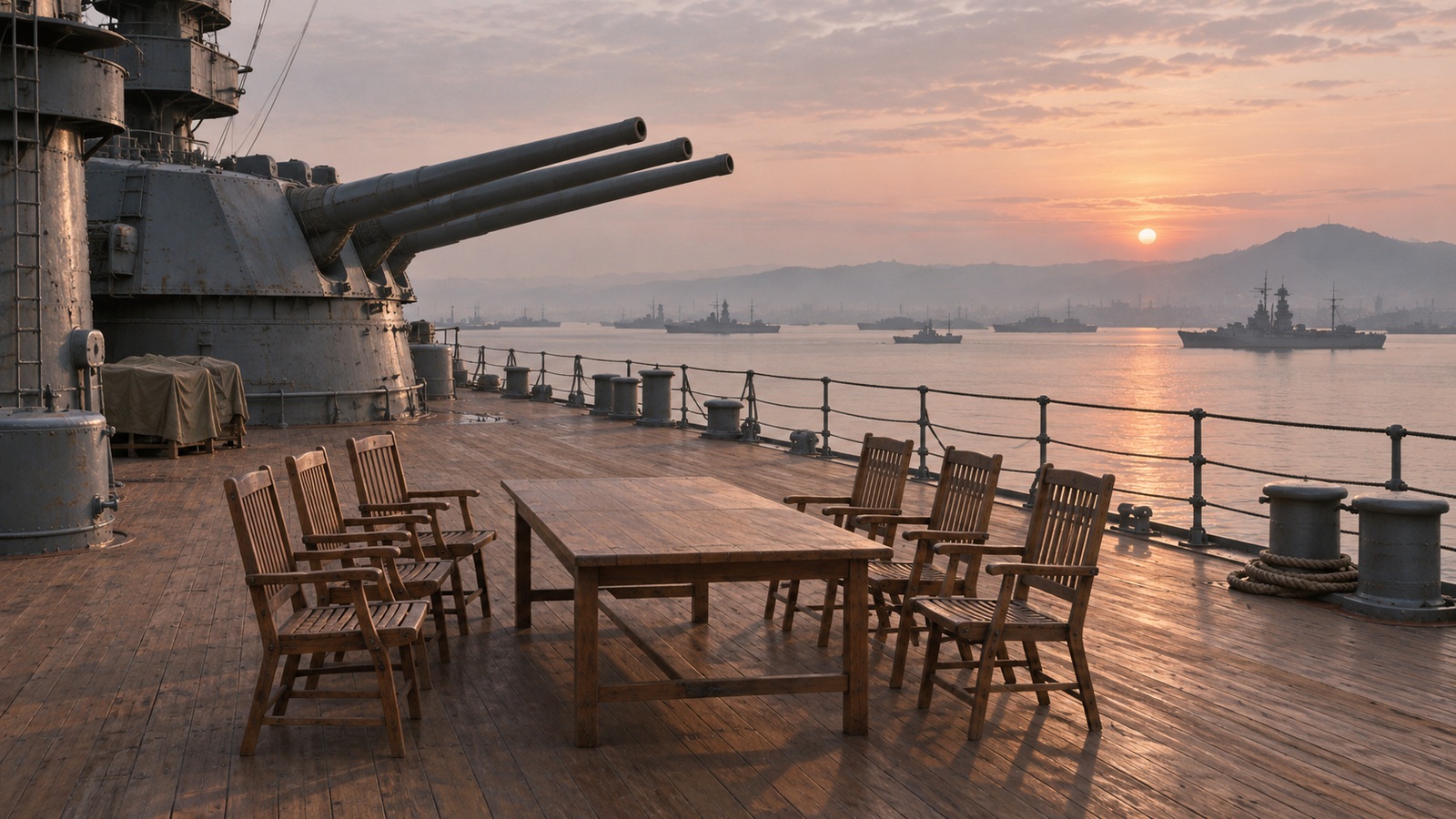
The formal surrender ceremony aboard USS Missouri in Tokyo Bay on September 2, 1945 supplied a recognizable endpoint to the military chronology. Its signatures did not immediately free every prisoner, return every displaced person or settle every local confrontation, because scattered forces still needed instructions and practical surrender arrangements. Occupation, relief and transport then connected the accepted terms with people awaiting their consequences. Japan’s empire ended, while independence struggles and competing political claims shaped the region beyond the ceremony. China’s renewed civil war and the long journeys of repatriation belong to that postwar history, even though they do not move the date of the formal signing.
From Announcement to Implementation
August 15 and September 2 identify different public events rather than competing dates for one ceremony. The broadcast communicated acceptance in Japan; the Missouri ceremony recorded the formal surrender before Allied representatives. Scattered forces then had to receive instructions and carry out local surrender arrangements, while prisoners and displaced people still awaited recovery and transport.
A sound Pacific War timeline separates three things: when an event occurred, what changed immediately, and what consequences developed later. It also keeps parallel fronts visible, identifies the place behind a date, and distinguishes military conclusions from civilian recovery. Those habits make the familiar sequence more accurate without turning every entry into an exhaustive campaign history. They allow readers to follow the movement from December 1941 to September 1945 while remembering the earlier Asian war and the many communities whose experience extended far beyond the dates usually printed in bold.