How American Missions in the Middle East Are Organized
When a report says that the United States has conducted an operation in the Middle East, it compresses a large chain of decisions into a few words. Political leaders define objectives, military commands translate assignments into activity, host governments shape access, and service members carry out tasks within a wider network of support. The resulting mission might involve airlift, maritime security, advising, deterrence, evacuation, or combat. Each has a different relationship to American policy and the countries involved. Understanding that organization makes it easier to assess what an operation is intended to achieve, which institutions are responsible, and what its reported results actually show. The 1991 Gulf campaign, the 2006 Lebanon evacuation, and the campaign against ISIS illustrate how those arrangements work. Together, they show why a command, an operation, and a political objective describe different parts of the same undertaking.
Start With the Objective and the Authority
The 1990–1991 Kuwait crisis supplies a concrete starting point. Iraq had invaded and occupied Kuwait. The American-led coalition’s campaign to remove Iraqi forces had an identifiable geographical and political objective. That makes it different from an open-ended promise to create regional stability. A defined task permits questions about what military action accomplished and what problems remained outside its scope.
The authority also had several layers. UN Security Council Resolution 678, adopted in November 1990, authorized cooperating member states to use necessary means if Iraq failed to comply by January 15, 1991. Separately, the United States enacted Public Law 102-1 in January 1991. The international resolution and American domestic authorization were different documents issued by different institutions. Neither was simply an announcement that forces were capable of fighting.
This example explains why an operation’s name cannot answer every question about authority. The decision to deploy, the permission to use another country’s facilities, the domestic basis for force, and the international position can involve separate acts. A well-grounded account identifies the relevant decision for the particular campaign. These 1991 documents explain a historical case; their existence alone does not establish authority for an unrelated operation decades later.
Central Command Connects Services to Regional Tasks
U.S. Central Command, or CENTCOM, connects capabilities from different military services with regional assignments. Its components include Army Central, Naval Forces Central, Air Forces Central, Marine Forces Central, and Special Operations Command Central, each contributing particular professional capabilities. A service develops and sustains forces, while operational command arrangements connect assigned forces with the job they are expected to perform. An aircraft can therefore belong to the Air Force while supporting a joint operation involving other American services, with “combined” describing participation by more than one nation. Identifying both the component and the task explains how a regional undertaking works more clearly than assigning the entire operation to the service whose equipment happens to appear in a photograph.
Historical Operations Changed the American Role
The Rapid Deployment Joint Task Force was established in March 1980, followed by CENTCOM on January 1, 1983. The change created an enduring regional command rather than a temporary headquarters assembled for one crisis. It did not create a single permanent mission. The command subsequently supported undertakings with very different objectives, force requirements, and political consequences.
One later example was the establishment of Combined Joint Task Force–Operation Inherent Resolve on October 17, 2014. Its organizing purpose was the fight against ISIS in Iraq and Syria. The task force’s own history describes an evolving campaign rather than a replay of the 1991 Kuwait operation. The continuity lay in the regional institution; the target, partners, campaign, and intended outcome had changed. Treating all activity in Iraq as one war erases those distinctions.
Host Governments Are Decision Makers
An aircraft needs more than fuel and a crew to operate from a foreign airfield. It needs an accepted arrangement for being there, practical facilities, and permissions relevant to its movement and task. Port visits, transit, storage, and combat activity are different forms of access. A government’s cooperation in one area does not logically establish agreement to all the others.
The Combined Air Operations Center at Al Udeid Air Base in Qatar offers a concrete institutional example. Air Forces Central describes it as coordinating activities including airlift, aerial refueling, intelligence missions, and aeromedical evacuation. That combination connects combat aircraft with transport and support work. The facility’s role makes clear why regional access matters to an entire system, rather than only to the aircraft most often pictured in news coverage.
Access also requires continuing relationships. Construction, local employment, utilities, administration, and communication with host-country counterparts sustain a facility after the initial agreement. Host governments weigh their own interests and domestic circumstances. A large installation can be physically durable while the political conditions governing its use remain subject to negotiation. Geography supplies a location; cooperation makes that location usable for a particular purpose.
Different Missions Use Different Measures of Progress
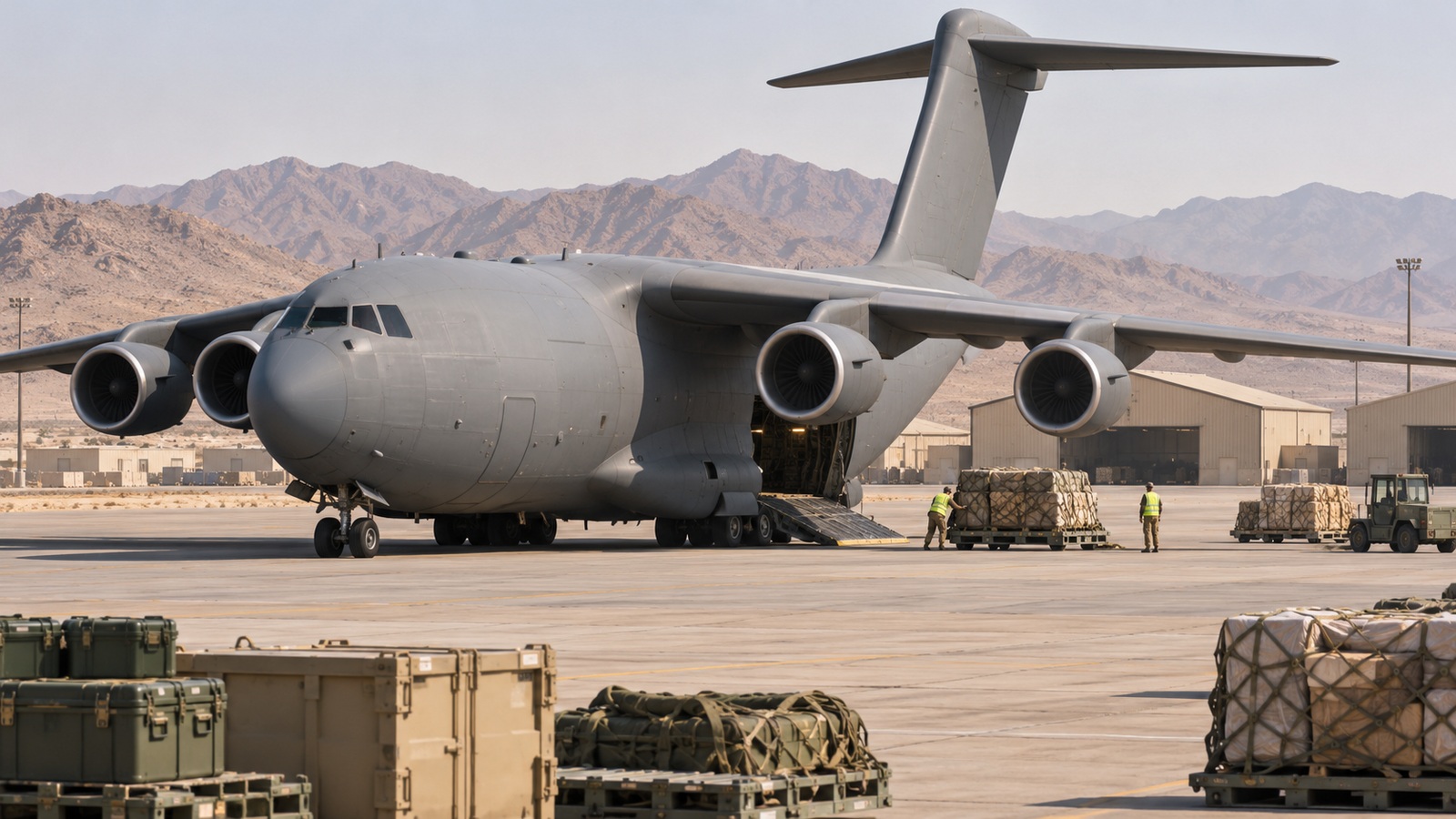
An airlift can be assessed through what was transported, where it arrived, and whether delivery served the intended purpose. An advisory mission raises a different set of issues, including whether a partner institution can sustain skills and operate independently. Maritime security involves commercial confidence and the continuity of movement as well as individual military actions. Counting sorties or patrols describes effort, but effort and progress are not identical. Consider an illustrative delivery of replacement parts: the flight is complete when the cargo arrives, but the supported unit benefits only when the right parts reach its maintainers and restore usable equipment. Transport output and operational effect describe different stages.
Deterrence presents a particular measurement problem because the desired outcome may be something that does not happen. The absence of an attack does not reveal with certainty why an adversary refrained. Political communication, alternative priorities, and unrelated constraints may all contribute. A careful assessment therefore explains the reasoning and available evidence instead of declaring that presence alone proves either success or failure.
The Deployment Continues After the Arrival Photograph
A ship’s or unit’s arrival is one stage in a deployment cycle that includes preparation, transport, maintenance, personnel support, and eventual relief or return. Uniformed personnel, civilian employees, and contracted support sustain different parts of that cycle, keeping equipment usable and the organization connected while it performs the assigned work. A replacement unit also needs time to prepare, move, and learn the local responsibilities before its predecessor leaves. Extending a rotation can consequently alter the schedules of people who have not arrived, as well as the training, family arrangements, and maintenance plans of those already serving. Assessing that whole cycle reveals practical costs and demands on future availability that a photograph of newly arrived strength cannot establish by itself.
Coalitions Bring Capacity and Additional Decisions
Operation Inherent Resolve illustrates why coalition participation has to be described through actual contributions. Governments can share the objective of defeating ISIS while providing different combinations of aircraft, training, advice, logistics, and support. Their personnel remain connected to national political decisions. A list of flags therefore establishes participation more readily than it explains who can perform a particular task.
Coordination brings those contributions together. A transport commitment has to meet an actual transport need; training has to connect with an organization able to use it. A shortage in one supporting function can limit the value of another contribution. Political restrictions also affect availability. Coalition planning is consequently both an organizational and diplomatic activity, requiring partners to understand what has been promised, what remains conditional, and which government can authorize a change.
Civilian Consequences Belong in the Assessment
American operations should be assessed alongside their effects on civilians and civilian institutions. The relevant effects vary with the mission, but can include immediate harm, interrupted services, displacement, or changes in local security relationships. A military report may describe the intended target or task while leaving those wider outcomes unsettled. Independent evidence and later assessment can be necessary to establish a fuller picture.
That evaluation should also distinguish military activity from humanitarian work. Armed forces can provide transport, engineering, medical capabilities, or emergency assistance, but humanitarian organizations operate under their own mandates and principles. Cooperation in a particular emergency does not make the organizations interchangeable. Maintaining that distinction helps readers understand both the contribution military logistics can make and the need for relief efforts to retain their appropriate civilian purposes.
The long-term consequences can be harder to summarize than the immediate action. A decision may influence public trust, partner institutions, or the incentives facing local actors. Those effects are not captured by equipment losses alone. An assessment that includes them can recognize operational achievements while still examining whether the broader policy produced an outcome that was sustainable and acceptable to the people involved.
The Lebanon Evacuation Shows the System at Work
In 2006, the State Department requested Defense Department assistance to evacuate Americans from Lebanon. Military helicopters and ships worked alongside contracted commercial transport, taking people from Beirut to Cyprus and onward. GAO later reported that nearly 15,000 Americans were evacuated. GAO also described twice-daily video conferences among key officials as an important coordination tool, introduced during the evacuation even though they were absent from the embassy’s emergency plan. This was an operation whose immediate purpose could be stated in human terms: move people out of danger and support their onward journey.
The same review identified difficulties in public communication and coordination between departments. Cyprus also needed reception capacity when evacuees arrived, with local hotels already close to capacity during the summer tourist season. State arranged emergency shelter and sought help organizing onward flights, extending the task beyond getting people out of Beirut. The case shows how consular decisions, transport, temporary accommodation, and onward travel connected across institutions. The evacuation total records a major achievement, while the review explains the additional capacity and coordination needed to complete the journey.
Transitions Need a Practical Handover
When an advisory mission transfers responsibility to a partner institution, a departure ceremony records an event rather than the whole outcome. The important question is which functions have changed hands. A partner may have trained personnel while still depending on outside maintenance, transport, or specialist advice. Identifying those dependencies makes the transition understandable and exposes the work that remains.
Equipment offers a straightforward example. Delivering vehicles adds an inventory, but keeping them available requires parts, trained maintainers, records, and a way to pay for future work. A training course can teach a skill without ensuring that qualified people remain in the relevant positions. Durable capacity comes from connecting the equipment, workforce, and supporting organization. This is why institutional development can continue after the most visible transfer is complete.
The same approach applies when a named operation ends. Personnel must move, equipment and records must be handled, and responsibilities must be assigned elsewhere or deliberately concluded. The final policy assessment then returns to the original objective. The Kuwait campaign, Lebanon evacuation, and defeat-ISIS campaign require different questions because they sought different results. Understanding American operations begins with that specificity: who was responsible, what they were asked to achieve, how their contributions connected, and what remained after the immediate task.